Tracking Multiple Mining Payout Streams in One Wallet
A miner running BTC on PPS+ and a second coin on PPLNS is paid on two different clocks. At 1 PH/s and today's network difficulty of 132.76 T, the PPS+ side credits roughly 0.0000187 BTC every hour — about $1.58 at $84,692 per BTC — while PPLNS credits only arrive after a block reaches six confirmations. Putting those streams in one account with one ledger turns reconciliation from a spreadsheet project into a two-minute check.

Key takeaways
- PPS+ settles against current difficulty every hour: 1 PH/s produces about 0.0000187 BTC per hour, roughly $1.58 at a $84,692 BTC price.
- PPLNS pays after a block receives 6 confirmations, weighted by each miner's share of pool hashrate over the last 5 difficulty rounds — a completely different cadence.
- The listed fee is 4% on the PPS-settled block-reward component and 2% on the transaction-fee component, so a single "6%" line in a spreadsheet is wrong.
- A 250 TH/s machine grosses about 0.000112 BTC ($9.50) per day, which is high enough to justify a per-stream ledger and low enough that one missed offline day hurts.
Why the numbers move
Every payout stream is a share calculation wearing different clothes. Bitcoin pays 3.125 BTC of subsidy per block and aims for 144 blocks a day, which puts 450 BTC of new supply on the network daily — about $38.1 million at today's price. Your slice of that is your hashrate divided by total network hashrate, and at 1,003 EH/s the denominator is enormous: 100 TH/s is roughly 9.97 × 10⁻⁸ of the network.
What differs between streams is not the arithmetic but the timing and the fee line. A stream that settles hourly gives you 24 credits a day to reconcile. A stream that settles per block gives you an irregular number of credits that varies with pool luck. Two streams in the same account therefore produce a payout history with a different shape in every month.
Difficulty is the shared input
Both streams are priced off the same difficulty — 132.76 T when this was written — so a difficulty change moves all of them at once. That is actually convenient: a single difficulty column in your ledger explains most of the month-over-month drift, and everything left over is either hashrate failure or a fee component you misread.
What changes your payout
The practical question for anyone tracking several streams is which one to look at when a total looks wrong. This table is the order in which to check.
| Stream | When it lands | Listed fee | What actually moves it |
|---|---|---|---|
| PPS+ block-reward component | Every hour, against current difficulty | 4% | Difficulty, valid shares submitted, worker uptime |
| Transaction-fee component | With PPLNS logic | 2% | On-chain fee volume, not your hashrate alone |
| Full PPLNS mode | After 6 confirmations of the block | 2% on rewards and fees together | Pool luck plus your share of pool hashrate over 5 rounds |
| Merged-mining output | Alongside the parent-chain payout | Follows the payment mode in use | Parent chain hashrate and auxiliary chain difficulty |
Read that table twice if you compare pools for a living. The most common error is treating PPS+ as a flat 6% haircut on everything; the 4% applies to the block-reward component settled per share, and the 2% applies to the transaction-fee component, which is usually the smaller slice. The pool publishes that breakdown itself because the distinction gets flattened so often.[1]
The second row is why multi-stream miners keep two views: one for hashrate-derived income, which they control, and one for fee-derived income, which they do not. Mixing them into a single balance hides the fact that a quiet fee market can cut one line by a third while the other line stays flat.
Worked example: 1 PH/s across two streams for 24 hours
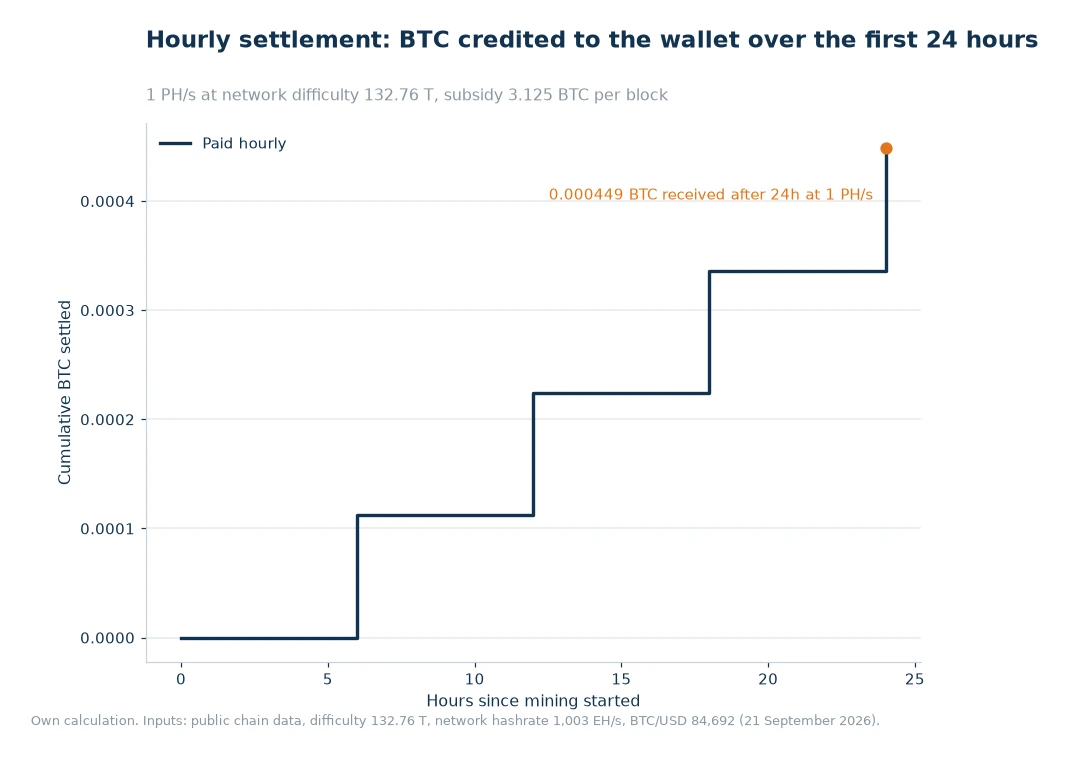
Take 1 PH/s pointed at BTC on the default PPS+ mode. The daily gross expectation is 0.000449 BTC, or $37.99. Split into hourly credits that is 0.0000187 BTC — about $1.58 — 24 times a day, which is what makes the stream easy to audit: if a day shows 18 credits instead of 24, you lost roughly six hours of hashrate and can find the reason in worker logs rather than in payout maths.
Now add a second coin on PPLNS from the same account. Suppose that stream contributes 30% of gross income, or about $11.40 a day at the same hashrate. Its credits are lumpy: some days it pays twice, some days not at all, and the five-round rolling window means a large miner who joined yesterday dilutes your share temporarily even though your machines never stopped.
That is the reconciliation problem in one line. The PPS+ stream is a metronome you can predict to the hour; the PPLNS stream is a sample from a distribution. A single wallet view that shows both, with separate entries per stream, lets you confirm in seconds that the hourly rail kept its cadence and that the PPLNS rail is merely between blocks.
Cost side, for context: 10 PH/s of hardware running at 20 J/TH draws about 200 kW, which is 4,800 kWh a day and roughly $288 of electricity at $0.06/kWh against $379.93 of gross mining income. The $91.93 gap is what pays for everything else, and it is the reason a payout rail that charges transfer fees quietly eats into a margin that already looks thin.
This is where a wallet built into the mining account earns its place. When mining credits land directly in the same account that holds deposit and withdrawal addresses, balances and conversion, the number of moving parts between hashrate and spendable money drops. Historically that path included at least one exchange deposit and one withdrawal; ViaBTC settles mining earnings to the account with zero-fee mining payouts and keeps balances, auto conversion and withdrawal addresses behind the same login as the dashboard.[2]
What to check monthly
Six checks, run in this order, catch almost every payout anomaly. They take about twenty minutes a month on a small farm.
- Credits per stream. Count hourly entries for the PPS+ rail. A short day is a hashrate or connectivity problem, not a fee problem.
- Effective fee. Divide the fee lines by gross income. If the result is far from the 4%/2% structure, you are looking at a different payment mode than you think.
- Worker uptime. Reconcile dashboard hashrate against the uptime you paid hosting for. Every 1% of downtime at 1 PH/s is about $0.38 a day of gross income.
- Difficulty drift. A difficulty rise compresses all streams at once; -2.12% was the estimate for the next adjustment when this was written, and it moves in both directions.
- Withdrawal cost. Zero-fee mining payouts do not help if you then pay internal transfer fees to move coins between products inside the account.
- Cash-flow gaps. If hourly credits are not enough to cover a hosting invoice in a dry PPLNS month, a collateral-pledged loans position is the alternative to selling coins at the bottom of a variance cycle.
The single most useful habit is refusing to move coins the moment they land. Consolidated balances over a month produce one withdrawal instead of thirty, and one fee event instead of thirty — a habit that matters more at 250 TH/s than at 10 PH/s, because at $9.50 of gross income per day, every unnecessary transfer is a visible percentage of income.
If you route mining output through a single account, the natural home for it is the ViaBTC Crypto Wallet, which sits inside the same dashboard as the mining statistics you already watch, so a payout entry and the hashrate that produced it are never more than one click apart.
Frequently asked questions
Do mining pools cost anything to join?
Joining is free; the pool earns from its fee on settled payouts, which appears as a percentage of the block-reward and transaction-fee components.
Can I mine more than one coin at the same time?
Yes. Merged mining lets a machine secure a parent chain and an auxiliary chain together, and multi-coin pools support switching between chains without moving hardware.
How often are PPS+ earnings paid out?
Hourly, against current difficulty. PPLNS distributions follow the blocks the pool finds and land after those blocks receive six confirmations, so the two rails will never share a schedule.
How much hashrate produces a payout worth tracking daily?
At current difficulty, 100 TH/s returns about 0.0000449 BTC a day, or $3.80 gross before the listed fee, which is small enough to be lost in a rounding error and large enough that a week of downtime is expensive.
Run the two-clock check before the next invoice
Write down the expected credits per day for each stream, then compare that number against the account history once a month. If the hourly rail is short, look at worker uptime; if the PPLNS rail is short, check pool luck and your rolling five-round share before touching hardware. Keep everything in one account so the comparison takes minutes, and set a reminder for the day after each difficulty adjustment, when all streams reprice at once.
Data and sources: ViaBTC pricing and fee documentation[1] and the published fee breakdown[2]. Network difficulty (132.76 T), network hashrate (1,003 EH/s) and the BTC price of $84,692 come from public chain data and market feeds read on 21 September 2026; payouts and earnings figures are own calculations from those inputs and change as difficulty and price move.