M0602C-112 vs M0601C-111 for Space-Constrained Applications
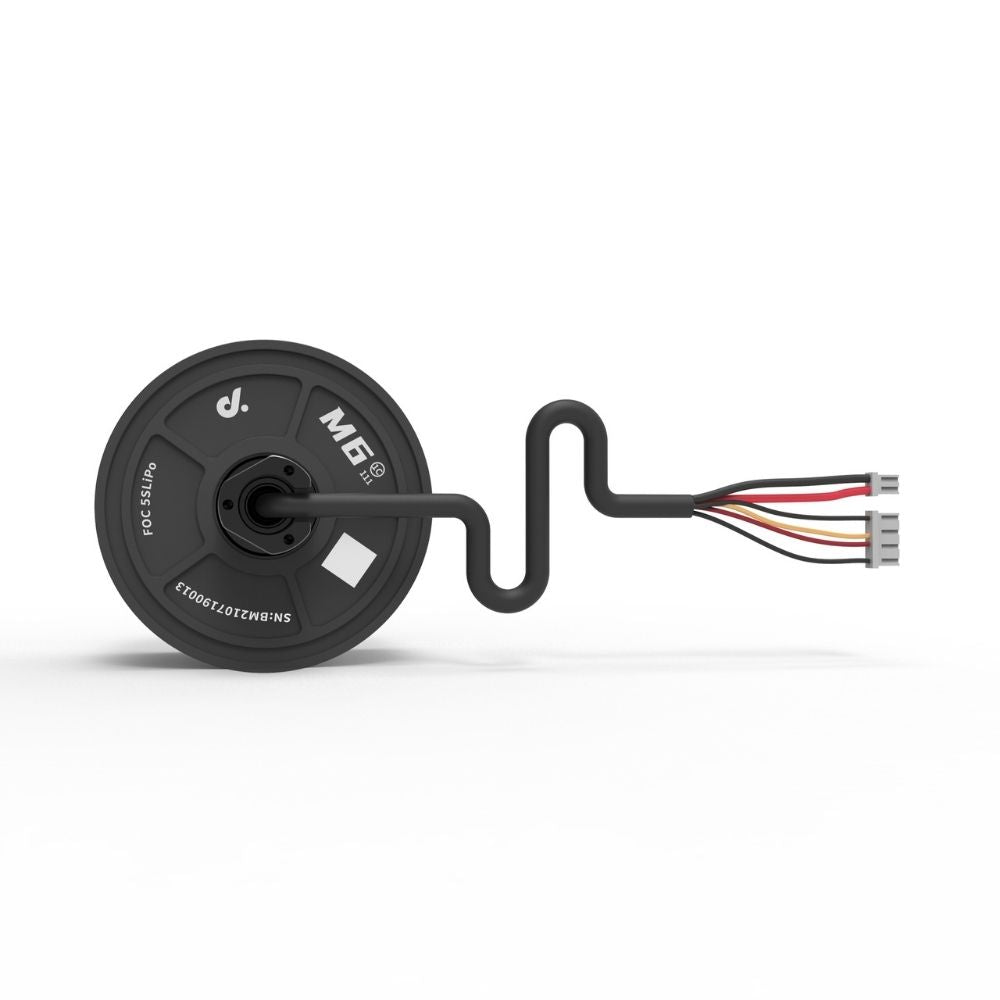
M0602C-112 and M0601C-111 serve different compact robotic requirements. M0602C-112 provides higher torque capacity and thermal margin for mobile robots carrying heavier loads, while M0601C-111 focuses on smaller installation volume for lightweight platforms. With robot chassis sizes often below 500 mm and operating cycles reaching 6–12 hours per day, motor selection requires balancing dimensions, torque density, heat management, and feedback accuracy.
Space-limited robotic platforms increasingly require smaller drive systems because batteries, computing units, cameras, and sensors occupy more internal space. Traditional motor plus gearbox assemblies may increase installation thickness by 20–40 mm because of additional transmission components. Direct-drive motors reduce mechanical interfaces by connecting the motor output closer to the wheel, improving packaging efficiency for applications where every millimeter matters.
A compact motor design affects the entire robot structure. A thinner wheel module allows more room for battery cells, embedded controllers, and communication hardware. In mobile robots with chassis widths between 150 and 500 mm, the drive module arrangement can determine whether additional sensors or larger energy storage systems can be installed.
"A smaller actuator package allows engineers to redesign the complete robot layout instead of only replacing the motor."
The comparison between M0602C-112 and M0601C-111 depends on how the robot is used. A delivery robot operating indoors may require repeated acceleration, higher payload support, and long operation periods, while an educational robot may prioritize minimum size and low weight. Different applications require different combinations of torque output and installation flexibility.
| Design Requirement | M0602C-112 | M0601C-111 |
|---|---|---|
| Main priority | Torque capability and stable operation | Minimum installation volume |
| Typical robot type | Service robots, AGVs, inspection platforms | Lightweight robots and compact mechanisms |
| Payload condition | Medium to high payload | Low to medium payload |
| Space requirement | Compact installation | Extremely limited space |
| Operating condition | Longer continuous duty cycles | Shorter or lighter duty cycles |
Mechanical integration is closely related to wheel design. The torque generated by a motor is converted into ground force through the wheel radius:
[
F=\frac{T}{r}
]
A motor producing 1 Nm torque can generate approximately 25 N of ground force with a 40 mm wheel radius, 20 N with a 50 mm radius, and 16.7 N with a 60 mm radius. Smaller wheels increase ground force but reduce travel distance per rotation, requiring designers to evaluate speed and traction together.
Wheel radius | Ground force from 1 Nm torque
40 mm | 25 N
50 mm | 20 N
60 mm | 16.7 N
Robot operating conditions also influence motor selection. Indoor autonomous robots commonly operate between 0.3 and 1.5 m/s, while inspection robots may move slower to improve positioning accuracy. Many robotic platforms use approximately 30–70% of rated torque during normal movement and reserve additional torque for acceleration, turning, ramps, and uneven surfaces.
M0602C-112 is suitable for systems where additional torque margin is required. For example, a mobile platform carrying 30–50 kg equipment may experience short periods of high current demand during startup or direction changes. A motor with greater thermal capacity can maintain performance during repeated movement cycles.
M0601C-111 addresses applications where mechanical space is more restricted. Small autonomous platforms often have limited internal volume because batteries and processors occupy most of the chassis. A compact motor for low profile mobile robot design allows manufacturers to reduce wheel module thickness while maintaining direct-drive operation.
Direct-drive structures have become more common in robotics after 2015 because many applications require smoother low-speed movement and accurate wheel control. Gear reduction systems add transmission parts that may introduce backlash and mechanical adjustment requirements. Direct-drive systems remove several intermediate components, reducing assembly complexity and improving response during low-speed operation.
"Removing mechanical transmission stages improves motion consistency when robots operate at slow speeds."
Thermal performance becomes more important when motor dimensions decrease. Smaller motors have less surface area available for heat dissipation, making winding temperature management important during continuous operation. Copper resistance increases by approximately 23% when temperature rises from 20°C to 80°C, which increases electrical losses.
| Operating Factor | Typical Range |
|---|---|
| Daily operating time | 6–12 hours |
| Indoor robot speed | 0.3–1.5 m/s |
| Continuous torque usage | 30–70% of rated torque |
| Temperature range for copper comparison | 20°C–80°C |
The difference between M0602C-112 and M0601C-111 becomes clearer when considering duty cycle. A robot working continuously for 8 hours per day may require more thermal margin than a research platform operating for 1–2 hours. Motor selection should include operation duration, acceleration frequency, payload changes, and cooling conditions.
Control performance is another factor in compact robot design. Direct-drive motors require accurate feedback because there is no gearbox reduction between the motor and mechanical load. Encoder information is used for velocity regulation, position control, and navigation correction.
Typical control systems operate at different update frequencies:
| Control Function | Typical Frequency |
|---|---|
| Current control | 5–20 kHz |
| Velocity control | 500–2000 Hz |
| Position control | 100–500 Hz |
| Communication update | 50–1000 Hz |
A 16-bit encoder provides 65,536 position points per revolution. At 300 rpm, this resolution allows the controller to measure small angular changes while maintaining smooth speed estimation. For autonomous robots, accurate wheel feedback reduces accumulated positioning errors during long-distance movement.
Communication design also influences motor integration. RS485 and CAN-based networks are commonly used because multiple motor controllers can share communication lines. A typical RS485 system supports 16–32 nodes with cable distances of 50–120 meters depending on data rate and environment.
| Communication Parameter | Typical Range |
|---|---|
| Baud rate | 115200 bps–1 Mbps |
| Network nodes | 16–32 |
| Cable distance | 50–120 m |
| Position update rate | 50–1000 Hz |
The choice between the two motors depends on the application environment.
| Application Example | Suitable Choice |
|---|---|
| Indoor delivery robot | M0602C-112 |
| Autonomous inspection platform | M0602C-112 |
| Educational robot | M0601C-111 |
| Lightweight mobile platform | M0601C-111 |
| Small robot with strict height limitation | M0601C-111 |
M0602C-112 provides advantages when torque reserve, continuous operation, and payload capability are important. M0601C-111 provides advantages when installation height, weight reduction, and mechanical flexibility are more important. Both designs support compact robotic systems, but they address different engineering requirements.
The selection process should consider wheel size, robot mass, operating hours, thermal conditions, and control requirements together. A motor that fits the available space but lacks torque margin may reduce performance, while an oversized motor may limit battery capacity and internal layout options. The most suitable choice depends on the balance between mechanical size and required operating capability.