How Does Industrial Hose Material Affect Performance and Service Life?
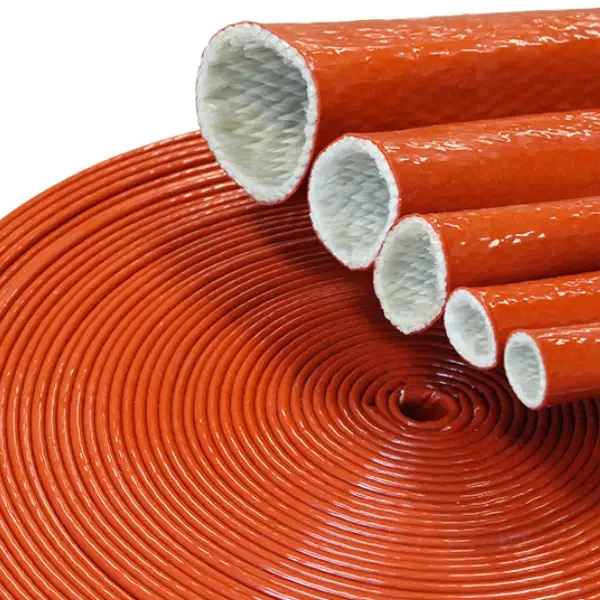
Industrial hose material affects chemical compatibility, working temperature, abrasion resistance, flexibility, permeation, and aging rate. A hose rated for 150 psi can still fail early when its tube compound is incompatible with the fluid or when heat exceeds its rated range. Current Gates industrial specifications show chemical-hose temperature limits from about -40°F to 300°F depending on the polymer, while many chemical-transfer hoses use a 4:1 design factor. EPDM, NBR, natural rubber, UHMWPE, FEP, PTFE, and polyurethane perform differently under oil, steam, solvents, weather, and abrasive solids. Material selection therefore changes both usable operating range and replacement frequency.
A hose is better understood as a layered pressure component than as a single piece of rubber. The inner tube contacts the fluid, textile or steel reinforcement contains pressure, and the cover protects the structure from abrasion, weather, oil, and mechanical contact. A material mismatch in any one layer can shorten service even when the remaining layers look intact. Gates’ 2026 industrial catalog, for example, lists chemical-transfer constructions with FEP, CPE, XLPE, UHMWPE, and EPDM tubes while commonly pairing several of them with EPDM covers, showing why tube and cover materials often solve different problems.
Chemical compatibility usually determines the inner-tube material first. NBR is widely used with petroleum oils and many hydrocarbon-based fluids because nitrile formulations resist oil swelling better than EPDM. EPDM is commonly used with water, weather exposure, selected acids and alkalis, but is generally unsuitable for petroleum fuels and oils. Gates’ polymer table separates compatibility into “preferred,” “acceptable for intermittent contact,” and “not recommended,” rather than treating resistance as a simple yes-or-no property. The 2024 table also states that its ratings describe polymer effects only; couplings and other hose components must be checked separately.
That distinction becomes more important when concentration changes. A polymer that tolerates a dilute chemical may soften, swell, lose tensile strength, or develop surface damage at a higher concentration. Contact time matters as well: a hose carrying a fluid for 20 minutes during transfer does not experience the same exposure as one filled continuously for 24 hours a day.
Chemical compatibility should be checked using the actual fluid name, concentration, temperature, and expected contact time. “Chemical hose” is a product category, not a guarantee that one tube compound can carry every chemical.
Temperature then changes the same compatibility calculation. Gates lists Chem Master EPDM hose with an EPDM tube rated to +250°F (+121°C), but the manufacturer advises contacting application engineering when chemicals are conveyed above +125°F (+52°C). The hose is rated to 150 psi and uses a 4:1 design factor, yet its acceptable temperature still depends on the chemical being transferred. Pressure, temperature, and chemistry cannot be separated when predicting service life.
The range between material families can be large. Gates’ 2026 chemical-hose data lists FEP-tube Chem Master XTreme at approximately -40°F to 300°F, CPE at -40°F to 275°F, XLPE at -40°F to 250°F, UHMWPE at -40°F to 212°F, and EPDM versions around -40°F to 250°F. A 50°F difference in upper temperature rating may determine whether a hose remains elastic or experiences accelerated hardening and layer separation in a hot process.
| Material | Common strength | Common limitation | Typical industrial use |
|---|---|---|---|
| NBR | Petroleum oil and fuel resistance | Weaker ozone/weather resistance than EPDM | Oil, fuel, hydraulic-fluid transfer |
| EPDM | Water, ozone, weather, selected chemicals | Poor fit for many petroleum fluids | Water, steam, outdoor chemical service |
| Natural rubber | High elasticity and abrasion resistance | Limited petroleum-oil resistance | Sand, slurry, bulk solids |
| UHMWPE | Broad chemical resistance and low-friction surface | Temperature limits vary by construction | Chemical transfer |
| FEP/PTFE family | Broad chemical and high-temperature capability | Higher material cost, different flex behavior | Aggressive chemical processing |
| Polyurethane | Strong abrasion resistance | Chemical compatibility needs verification | Pneumatic and abrasive applications |
Abrasion creates a different wear pattern. Gates’ comparative polymer information rates natural rubber/SBR, UHMWPE, polyurethane, and nylon among materials with strong abrasion performance, while NBR is generally rated lower for abrasion than materials specifically selected for solids handling. In a hose transferring sand, cement powder, mineral slurry, or granulate, wall loss can occur even when chemical compatibility is excellent.
Velocity has a major influence because particle impact increases as solids move faster through bends. Wear often concentrates on the outside radius of an elbow or curved hose section rather than spreading evenly through the bore. Increasing wall thickness may extend replacement intervals, but routing changes can also help: fewer tight bends reduce repeated particle impact in one location.
External abrasion deserves separate treatment because the cover can wear without the tube touching abrasive media. Hoses dragged over concrete, steel grating, aggregate, or machine frames gradually lose cover thickness and may expose textile or wire reinforcement. A hydraulic hose protector can add a sacrificial barrier where rubbing, contact, or repeated movement is expected, although protection does not increase the hose’s rated working pressure or correct an undersized bend radius.
Flexibility becomes more important once the hose moves rather than remaining fixed. Repeated bending near a coupling creates alternating tension and compression through the cover, reinforcement, and tube. A stiff compound can transfer more bending stress to the fitting area, while a more flexible construction may distribute movement over a longer section. A hose installed below its specified minimum bend radius can experience reinforcement distortion even when system pressure remains below 100% of its working-pressure rating.
Pressure rating itself comes mainly from the full construction rather than tube polymer alone. Textile braid, steel-wire braid, spiral reinforcement, and wire helix serve different mechanical purposes. Gates chemical-transfer products commonly use synthetic textile reinforcement plus wire helix for suction service; several published models operate at 150 psi with a 4:1 design factor. A 4:1 factor does not permit routine operation above rated pressure—it describes the relationship used in the hose design and qualification.
Pressure cycles are harder on a hose than an identical static pressure held continuously. Pumps, hydraulic equipment, loading arms, and mobile machinery can create repeated pressure changes while the hose simultaneously bends or vibrates. Reinforcement fatigue may therefore become the limiting condition long before the inner tube shows visible chemical deterioration.
Environmental exposure then shifts attention to the cover. Ozone, ultraviolet light, rain, oil mist, hot surfaces, cleaning chemicals, and winter temperatures all alter polymer aging. Gates’ material comparison rates EPDM strongly for weather and ozone resistance, while NBR is listed as relatively poor to fair in that category. A hose carrying oil indoors may benefit from NBR properties, while an outdoor assembly can require a different cover compound even when the conveyed fluid stays unchanged.
Cleaning procedures can shorten life in food, beverage, pharmaceutical, and sanitary plants because the hose sees additional chemicals and heat outside normal production. Parker’s 2024 industrial hose safety guidance gives one clear example: for a listed disinfectant condition using peracetic acid at 1%, NR/NBR/silicone materials are shown with a maximum of 25°C, while EPDM/BIIR/UPE/PTFE materials are shown at 40°C. The same guide notes that cleaning frequency and exposure time affect rubber-hose service life.
A hose carrying product at 30°C for eight hours may still be exposed to hotter water, caustic solution, disinfectant, or steam during cleaning. Maintenance records should include cleaning temperature and concentration, not only production temperature.
Permeation also matters even when there is no visible leak. Small molecules can pass through polymer walls over time, with rate affected by material, pressure, temperature, wall thickness, and fluid type. Gas, solvent, and volatile-chemical service therefore needs closer review than ordinary water transfer. Fluoropolymer liners such as FEP or PTFE are often considered when broad chemical resistance or elevated temperature is required; Gates’ current FEP chemical-hose range extends to 300°F, about 50°F above its listed EPDM chemical-hose maximum.
Service life finally depends on how closely the selected material matches real operating conditions. Inspection should look for swelling, softening, hardening, cracks, blisters, cover wear, exposed reinforcement, coupling movement, permanent flattening, and leakage. Replacement intervals should not be copied automatically from another machine because two assemblies with the same 1-inch inside diameter can experience different chemicals, cycle counts, bend radii, cleaning routines, and ambient exposure.
A useful purchasing specification records fluid identity, concentration, minimum and maximum temperature, normal and peak pressure, vacuum requirements, bend radius, movement frequency, outside abrasion, cleaning media, and coupling type. When manufacturers publish a limit such as 150 psi, -40°F, 250°F, or a 4:1 design factor, that number should be read together with the product’s chemical-resistance table and application notes. A pressure rating alone is not a service-life rating.